Office & Occupational Lenses in Amman
Clear Vision for Reading, Computer Work and Your Workspace After 40
Office lenses, also known as occupational lenses, are prescription lenses designed for near and intermediate vision. They are intended primarily for people aged 40 and over whose age-related loss of near focusing ability has begun to affect reading and computer work.
You may also hear the terms computer glasses or computer lenses. These are broader descriptions: not every pair of computer glasses uses the variable-power office lens designs discussed on this page.
If your reading glasses make your phone clear but leave your computer screen blurred, or you lift your head to find the screen area in your progressive lenses, glasses tailored to your working distances may help.
At Eye 2 Eye Optical in Sweifieh, Amman, we specialise in selecting, measuring and fitting office lenses. We assess your visual needs, use ZEISS i.Terminal technology for digital fitting measurements, and provide frame adjustment and follow-up after collection.
What Are Office Lenses and How Do They Work?
Office lenses have a gradual change in optical power to combine support for reading with an extended range of intermediate vision. Some designs are described technically as occupational progressive lenses: progressive lenses tailored to particular working tasks and distances.
Rather than focusing on just one distance, they help you look between documents, your phone and your screen. Selected designs extend useful vision farther across a room.
The main difference from everyday progressive lenses is how the viewing areas are distributed. Office lenses give greater priority to near and intermediate tasks, while everyday progressives combine distance, intermediate and near vision.
Office lenses are not suitable for driving or activities requiring clear long-distance vision.
Who Are Office Lenses For?
Adults Aged 40 and Over with Changing Near Vision
As we age, our eyes gradually lose some of their ability to change focus for close objects. This is called presbyopia, and many people begin to notice it in their forties.
You may hold your phone farther away, need brighter light to read, or struggle to look between paperwork and a screen. Office lenses may be one suitable option after an eye examination.
These lenses are not the usual choice for children, teenagers or younger adults simply because they use screens. Their visual needs are different. Lens selection should follow an examination, rather than depend on screen hours alone.
People Who Need Clear Vision at Several Working Distances
Office lenses may suit you if you:
- Frequently look between reading material and a computer.
- Find that your reading glasses do not make your screen clear.
- Wear progressives but find the computer area restrictive during prolonged work.
- Change your head position or move closer to the screen to see clearly.
- Need to see close details and speak with people within your workspace.
They are not limited to office employees. Other jobs and hobbies involving near and intermediate tasks may also benefit, depending on the distances involved.
Office Lenses vs Reading Glasses and Everyday Progressive Lenses
Reading Glasses
Reading glasses are usually prescribed for one main close distance, such as a book or phone. A computer screen positioned farther away may therefore be less clear.
If you only need clear vision at one distance, single vision lenses prescribed for that distance may be sufficient.
Everyday Progressive Lenses
Progressive lenses, also called varifocals, provide distance, intermediate and near vision in one pair. They are practical for daily activities, although some wearers find their intermediate viewing area restrictive for sustained computer work.
Office Lenses
Office lenses dedicate more of their design to near and intermediate vision. An appropriate design can provide wider usable viewing areas for desk tasks and help you look at your screen with a more natural head position.
For some people, the practical solution is everyday progressives for general use and a separate pair of office glasses for work.
How Do We Choose the Right Office Lenses?
We begin with what you need to see. We ask about your reading and screen distances, the number of monitors you use, and whether you also need to see colleagues or objects farther across the room.
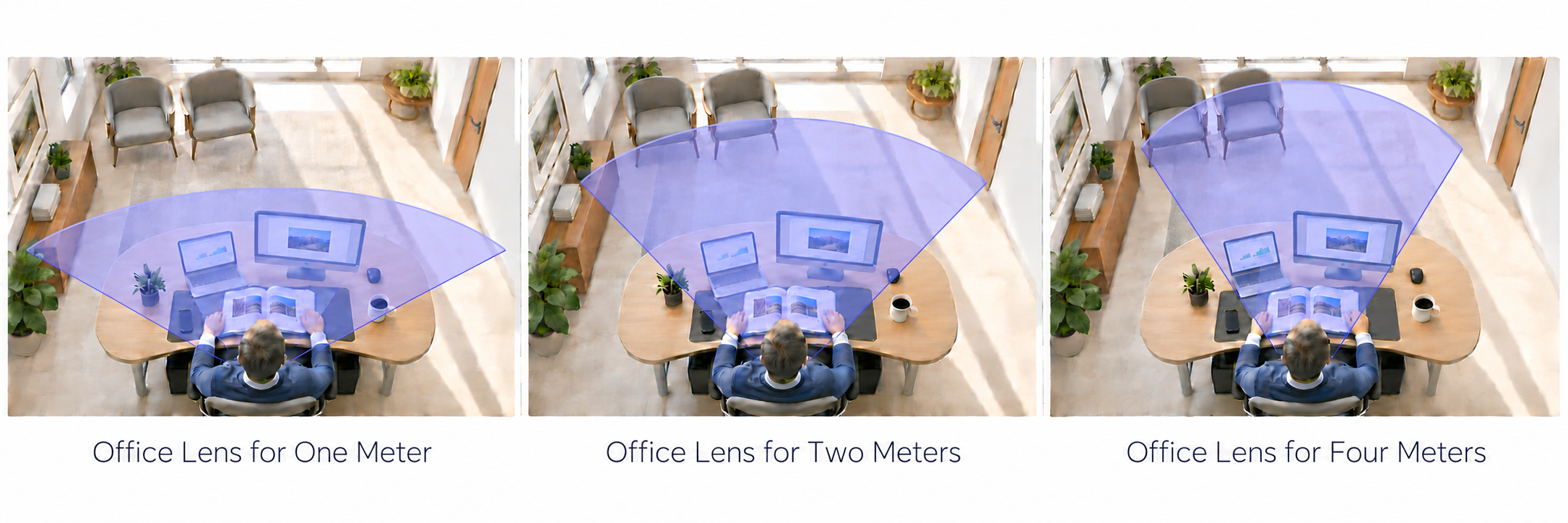
Viewing distance and the width of the clear viewing areas are different. Within the ZEISS Book, Near / Desk and Room options described below, the shorter-range designs give more priority to wider near and intermediate viewing areas. Extending the maximum range gives you greater reach across the room, with a trade-off in the width of those areas.
This is why a four-metre design is not automatically better than a one- or two-metre design. We balance usable field width and viewing range with your prescription, frame choice and everyday tasks.
The image above illustrates this relationship schematically: shorter and broader for the one-metre option, intermediate for two metres, and longer and narrower for four metres. It is not a scale drawing or a measured field-of-view map for an individual wearer.
ZEISS Office Lenses
ZEISS Office Lenses offer different working ranges and levels of design and personalisation. These are separate aspects of lens selection.
The one-, two- and four-metre ranges below refer to the ZEISS options described here. They are approximate maximum design ranges, not single fixed focusing distances or standard ranges shared by every manufacturer.
ZEISS Office Book — Up to Approximately 1 Metre
Book combines near vision with an extended working range out to approximately one metre. This can include reading, smartphone use and laptop or desktop computer work when the screen falls within the appropriate range.
Of these three ZEISS options, Book prioritises the widest usable near and intermediate viewing areas over a shorter maximum distance. It may suit someone whose main tasks stay within the desk area.
ZEISS Office Near — Up to Approximately 2 Metres
Near combines reading and computer vision with a maximum design range of approximately two metres, helping you see beyond the screen into the surrounding workstation.
It offers a balance between usable field width and reach: a longer range than Book, with wider near and intermediate viewing areas than Room in the corresponding ZEISS design comparison.
This working range is also called Desk in some ZEISS markets.
ZEISS Office Room — Up to Approximately 4 Metres
Room combines near and computer vision with a maximum design range of approximately four metres. It may suit people who need to alternate between desk tasks and people or objects farther across an indoor space.
Its greater reach comes with relatively narrower usable near and intermediate viewing areas than the shorter-range Book and Near / Desk options. That makes the right choice dependent on how you work, rather than on choosing the largest distance.
Your prescription, selected lens design, frame and fitting measurements affect the practical viewing range and field width. These figures do not guarantee identical results for every wearer.
ZEISS Office Plus, Superb and Individual
The range includes Plus, Superb and Individual, with differences in optical design and personalisation options.
Office Individual allows the maximum intermediate distance to be customised within approximately 1–4 metres, while taking relevant individual wearer and frame parameters into account.
At Eye 2 Eye Optical, we explain the available options and how their differences relate to your work, so you can make an informed choice.
Essilor Varilux Digitime Lenses
Essilor Varilux Digitime is another option designed for near and intermediate activities, including digital device use.
- Digitime Near: prioritises close activities such as phone use and reading.
- Digitime Mid: emphasises computer work while supporting near vision.
- Digitime Room: extends useful vision farther than the closer-range Digitime options.
We choose the design around your actual needs. Similar names such as Near and Room do not mean that different manufacturers offer identical viewing distances.
Digitime lenses are not suitable for driving.
Digital Fitting Measurements with ZEISS i.Terminal
Office lenses need both a suitable prescription and correct positioning in front of your eyes. We therefore check and adjust how the frame sits on your face before taking fitting measurements.
At Eye 2 Eye Optical, we use ZEISS i.Terminal digital measuring technology to help determine lens centration and fitting heights in your chosen frame. Additional personalisation parameters are used according to the requirements of the selected lens design.
Separately, we assess your screen distance, reading distance and other working distances. Frame fitting measurements and working-distance measurements complement each other.
When your glasses are ready, we check their fit and adjust them. We welcome you back for a review if a particular distance remains uncomfortable or your frame needs further adjustment.
Frequently Asked Questions About Office and Computer Lenses
Are Office Lenses and Occupational Lenses the Same?
Both terms are used for lenses tailored to near and intermediate working tasks. Occupational is a broader term, so we explain the actual lens design and intended use rather than rely on the name alone.
Is Every Pair of Computer Glasses a Pair of Office Glasses?
No. Computer glasses may use single vision lenses prescribed only for screen distance. Variable-power office lenses combine reading support with an extended intermediate range, depending on the selected design.
Can Office Lenses Replace My Everyday Glasses?
They are often a separate pair for selected working distances. They do not replace the distance correction you need for driving or other tasks beyond their intended range.
Are Office Lenses the Same as Blue-Light Filtering Lenses?
No. Office lenses describe the optical design and viewing distances. Blue-light filtering is a separate feature available in some lenses.
That feature alone does not automatically make glasses suitable for your screen distance or replace the need for an appropriate prescription and accurate fitting.
Does Everyone Over 40 Need Office Lenses?
No. This is the main age group these designs are intended for, but the choice depends on your examination and reading and computer needs. Reading glasses or single vision computer glasses may be sufficient for some people.
Will I Need Time to Get Used to Office Lenses?
Some wearers need time to become familiar with the different viewing areas. At collection, we explain how to use the lenses for your intended working distances and check your frame fit.
Getting used to the lenses varies from person to person. If a particular distance remains blurred or uncomfortable, return for a review of your prescription, lens choice, measurements and frame adjustment.
What Should I Bring to My Visit?
Bring your current glasses and prescription if available, and find out the approximate distance between your eyes and screen. If you use several monitors, a photo of your workstation with the distances noted can help.
Visit Our Office Lens Specialists in Amman
If you are 40 or over and reading or computer work means switching glasses or changing your sitting position, visit Eye 2 Eye Optical to assess your needs and compare suitable options.
We combine our office lens experience with eye examinations, ZEISS i.Terminal digital fitting measurements, professional fitting, adjustment and follow-up to help you choose glasses for the way you work.
Find us in Sweifieh, Amman, on Princess Taghreed Mohammad Street, opposite Al Baraka Mall and next to the Swatch store.