High-Index & Ultra-Thin Prescription Eyeglass Lenses
Would you like thinner lenses and a neater-looking pair of glasses? High-index lenses help reduce lens thickness while providing the correction your prescription requires.
Also known as ultra-thin lenses or thin and light lenses, they are especially useful when stronger prescriptions make lens edges more noticeable.
At Eye 2 Eye Optical in Sweifieh, Amman, we help you compare options from ZEISS, Essilor, Rodenstock and ASAHI-LITE and choose lenses and a frame that suit your vision, style and budget.
What Does Lens Index Mean?
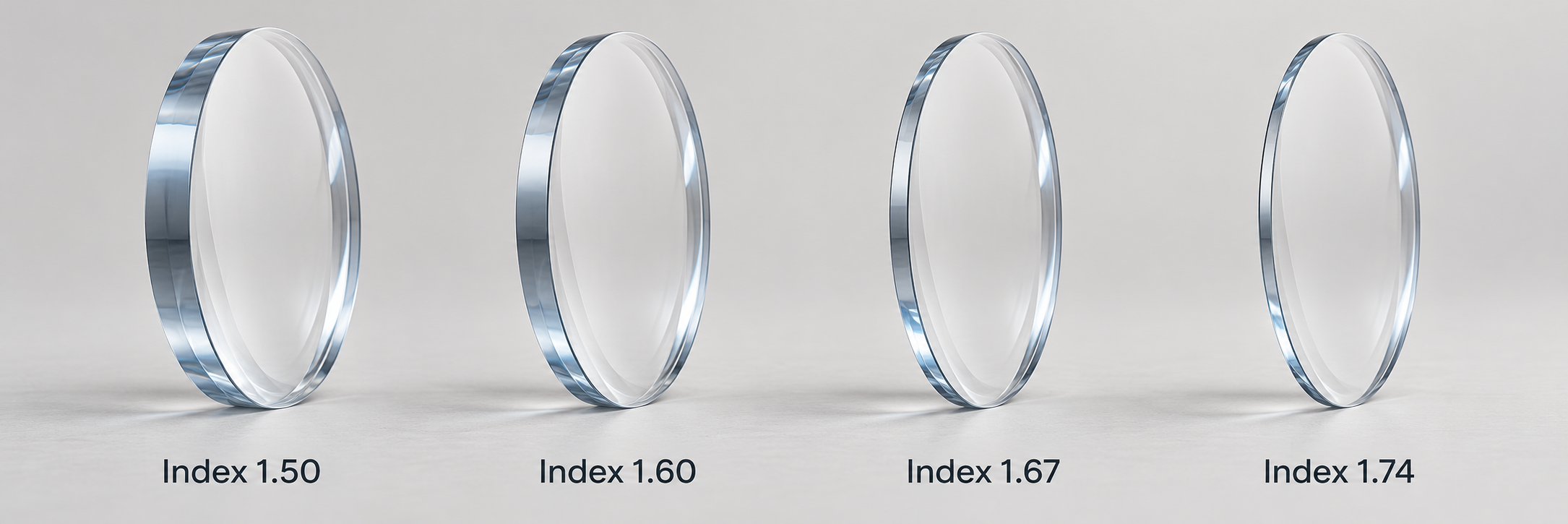
The refractive index tells you how a lens material bends light. A higher index allows the same prescription to be made with flatter curves, helping create a thinner lens.
The main options are 1.50, 1.60, 1.67 and 1.74. Index 1.50 is standard plastic; the higher-index options offer additional thinning.
In Jordan, these are often called “compressed lenses”. Their thinner profile comes from the material and design, rather than physically pressing an ordinary lens. Learn about lens materials from Mitsui Chemicals.
Our Guide to Choosing High-Index Lenses
Use this simple guide to explore the options for your prescription:
| Prescription (D) | Refractive index | Thinner vs 1.50* |
|---|---|---|
| 0.00–3.00 D | Index 1.50 — Standard | Reference (0%) |
| 3.25–4.00 D | Index 1.60 — Thin lenses | Up to 20% |
| 4.25–6.00 D | Index 1.67 — Super thin | Up to 40% |
| 6.25 D+ | Index 1.74 — Ultra thin | Up to 50% |
*Thickness reductions are based on the ZEISS comparison with standard Index 1.50 plastic lenses and may reach the percentages shown, depending on the prescription, lens design and chosen frame.
During your visit, we review your full prescription and help you choose lenses and a frame together for a slimmer, stylish result that suits you. The prescription ranges above refer to either minus or plus powers and serve as a starting guide for your selection.
1.50 Lenses — The Standard Option
Standard 1.50 plastic lenses may suit many lower prescriptions when the resulting thickness is acceptable in your chosen frame.
For a prescription such as −2.00 or +2.00, we may start with this option and assess whether a higher index would offer a worthwhile benefit.
1.60 Lenses — A Balance of Thinness, Optical Quality and Cost
For a prescription such as −3.50 or +3.50, 1.60 may be a suitable option for reducing thickness compared with standard plastic lenses.
It can provide a practical balance of appearance, optical quality and cost, depending on your complete prescription and chosen frame.
1.67 Lenses — Additional Thinning
For a prescription such as −5.00 or +5.00, it is worth comparing 1.67, especially when lens thickness is more noticeable.
With the same prescription, comparable design and identical dimensions, this material can allow a thinner lens than 1.60.
1.74 Lenses — An Ultra-Thin Option for High Prescriptions
For a prescription such as −7.00 or +7.00, 1.74 is an option to explore when a slimmer lens profile is a priority.
It is among the higher-index materials commonly used for plastic spectacle lenses. We compare its expected thickness and appearance with other suitable options to help you choose. Rodenstock lens material information.
Choosing Frames for High-Index Lenses
Your frame makes a difference to how thin your lenses look. Its size and shape, along with the position of your eyes within it, influence the finished result.
For short-sighted prescriptions, a smaller, well-centred frame can help reduce edge thickness compared with a larger frame. We help you try suitable styles and discuss the expected appearance before you order.
Lens Quality Involves More Than Thickness
Alongside refractive index, we consider optical design, lens coatings and accurate fitting.
An aspheric design may help produce a flatter lens profile and improve optical performance, with benefits that depend on the prescription. High-index describes the material; aspheric describes the design. Both can be combined in the same lens. ZEISS explains aspheric lens design.
Anti-reflective coatings help reduce surface reflections and improve lens transparency and appearance. Depending on the product, coatings may also make cleaning easier and improve scratch resistance.
International Brands, Personal Selection and Precise Fitting
Explore high-index and ultra-thin lens options from:
ZEISS · Essilor · Rodenstock · ASAHI-LITE
We explain the differences in materials, designs, coatings and prices so you can choose with confidence. Depending on the product and prescription, options may include single-vision or progressive lenses, light-adaptive lenses and sun tints.
Bring your prescription and current glasses, and tell us what you would like to improve. We will help you select suitable lenses and a comfortable frame.
We use ZEISS i.Terminal for digital fitting measurements according to your chosen lens requirements. Once your glasses are ready, we adjust the frame and explain how to care for your lenses.
Frequently Asked Questions About High-Index Lenses
Does a Higher Lens Index Mean Better Vision?
Clear, comfortable vision depends on an accurate prescription, a suitable lens design and precise fitting. A higher index helps reduce thickness; we consider all these factors together when recommending your lenses.
Are Thinner Lenses Always Lighter?
Not always. The final weight also depends on the lens material, size and design. We help you balance a slim appearance with comfortable everyday wear. HOYA lens material comparison.
Will 1.74 Lenses Completely Hide the Lens Edges?
1.74 lenses help reduce thickness, especially with stronger prescriptions. The amount of edge that remains visible depends on your prescription and frame. We help you choose a frame that suits the finished lenses for a neat appearance.
Can You Fit These Lenses into My Existing Frame?
Bring your frame with you. We will check its condition and suitability for your new lenses, then explain whether it is a good option or whether another frame could give you a better result.
Visit Us to Find Lenses That Suit Your Prescription
If you would like a slimmer-looking pair of glasses, visit us with your prescription and current glasses.
At Eye 2 Eye Optical, we help you compare high-index and ultra-thin lenses from international brands and choose options that suit your vision, appearance and budget.
Find us: Sweifieh, Princess Taghreed Mohammad Street, opposite Al Baraka Mall, next to Swatch — Amman, Jordan.
Explore our prescription eyeglass lenses or contact our team for more information.