Progressive & Multifocal Lenses
Progressive Lens Experts Since 2005
At Eye 2 Eye Optical in Amman, we are trained experts in choosing and fitting progressive lenses, and have been since 2005. In that time, we have fitted thousands of progressive lenses for different prescriptions, daily routines and wearing experiences, from first-time wearers to people coming from glasses they never felt comfortable in.
That experience helps us understand what you need from your glasses: comfortable vision for driving, computer work, reading, or moving between all three. We combine personal guidance, digital fitting measurements and follow-up after collection.
Ongoing Training with Lens Makers
Since 2005, we have kept pace with the lens makers we work with, ZEISS, Essilor and ASAHI-LITE, through specialist training each one provides on its own lenses and technologies. The most recent, in 2026, was with ZEISS, on precise digital fitting measurements with i.Terminal.
We also make a point of attending optical conferences and trade shows in Jordan, along with the leading international fairs: VisionPlus EXPO in Dubai, the Hong Kong International Optical Fair and SILMO Paris.
What you get: progressive lenses chosen, measured and fitted by an optometrist who keeps his knowledge current with the leading lens makers.
What Are Progressive Lenses?
Progressive lenses give you distance, intermediate and near vision in one pair of glasses. The lens power changes gradually from top to bottom, with no visible line. They are also known as varifocal or no-line multifocal lenses.
Multifocal is the broader term for any lens with more than one power. Progressive lenses are one type; bifocal lenses are another, with a separate, visible reading segment.
Who Are Progressive Lenses For?
Progressive lenses are usually considered when presbyopia, the natural age-related loss of near focusing, starts to make reading harder. Most people notice it in their forties. You may need progressive lenses if you:
- Hold your phone or a book farther away to read.
- Take off your distance glasses to see up close.
- Switch between glasses for distance, reading and computer use.
One Pair Instead of Three
You can live with three pairs of glasses, but in daily life one stays in the car, another at the office, and the reading pair is never with you when a message arrives. Progressive lenses cover most of your day in a single pair.
Age alone does not decide the right lens. We base the choice on your eye examination, your working distances and your experience with previous glasses.
How Do Progressive Lenses Work?
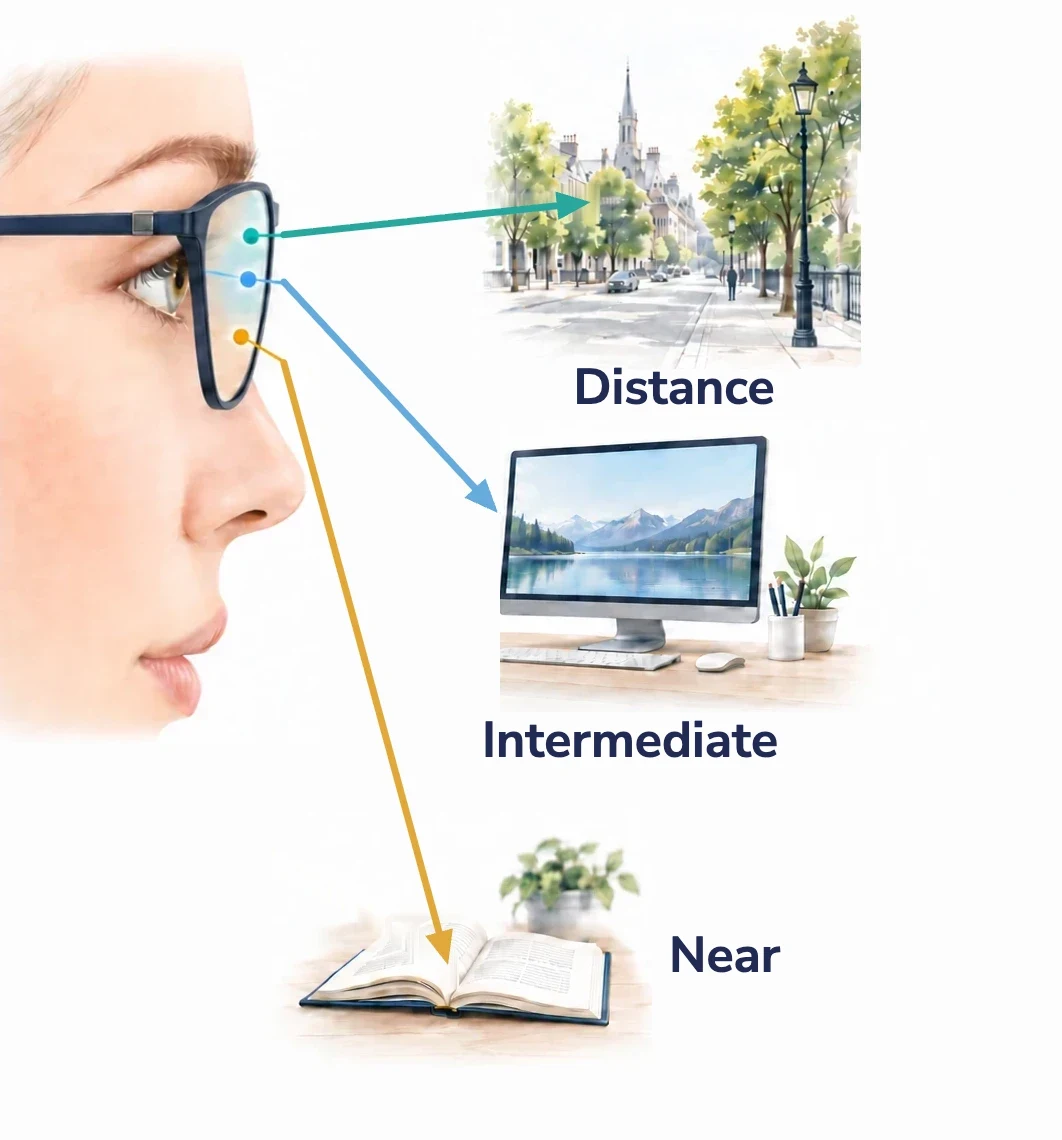
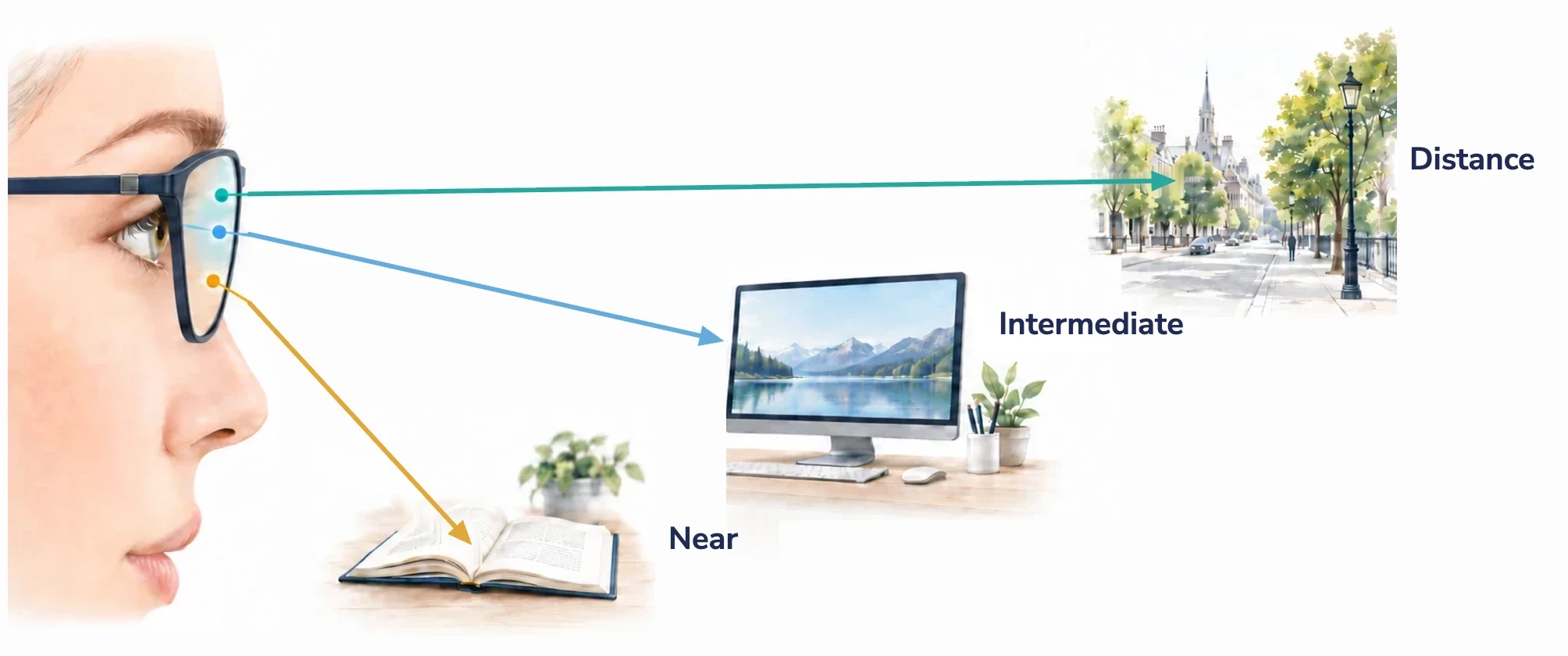
A progressive lens has three main viewing areas:
Distance
Upper area
Driving, television and faraway objects
Beyond arm’s length
Intermediate
Middle corridor
Computer screens and desk work
About 50–70 cm
Near
Lower area
Books, documents and your phone
About 30–50 cm
These distances are approximate and depend on your prescription and the lens design. Toward the edges of every progressive lens there are areas where vision is less sharp. Their size varies from one design to another, and this is where the real difference between lenses appears.
Why Designs and Prices Differ
Two lenses with the same prescription can feel completely different. The difference lies in the width of the clear viewing areas, the amount of peripheral blur, how smoothly vision moves between distances, and how closely the lens is tailored to your frame and face.
With a higher design level, you are not simply paying for a brand name. You are paying for a more precise optical design and wider viewing areas. That does not make the most expensive lens right for everyone. The right question is: which design fits your needs and your budget?
Not sure which level is right for you? Visit us, and we’ll compare the options for your prescription and budget.
ZEISS and Essilor Varilux Levels
ZEISS and Essilor Varilux each offer progressive lenses in four main design levels. As you move up, the viewing areas become wider, peripheral blur is reduced and the transition between distances becomes smoother.
| Level | ZEISS | Essilor Varilux | What you notice |
|---|---|---|---|
| Essential | Progressive Pure | Liberty 3.0 | Practical vision at all distances |
| Advanced | Progressive Plus | Comfort Max | Wider viewing areas and easier adaptation |
| Premium | Progressive Superb | Physio | Smoother transitions and sharper vision |
| Top tier | Progressive Individual 3 | XR Series | The widest viewing areas and the highest level of personalization |
We also offer progressive lenses from Rodenstock, KODAK, ASAHI-LITE, Synchrony and BRIVO in different design levels.
How We Help You Choose
- First-time wearers: we explain the viewing areas, help you choose the frame and tell you what to expect in the first days.
- Experienced wearers: we ask what works in your current pair and what you want to improve.
- Coming from uncomfortable glasses: we pinpoint where the difficulty lies: reading, screens, distance vision or the way the frame sits.
Before recommending any design, we talk about your work, driving, reading, screen use and budget. Your answers guide the choice.
Have progressive glasses you’ve never felt comfortable in? Bring them with you, and we’ll pinpoint the cause: the prescription, the lens design, the measurements or the way the frame sits.
Digital Measurements with ZEISS
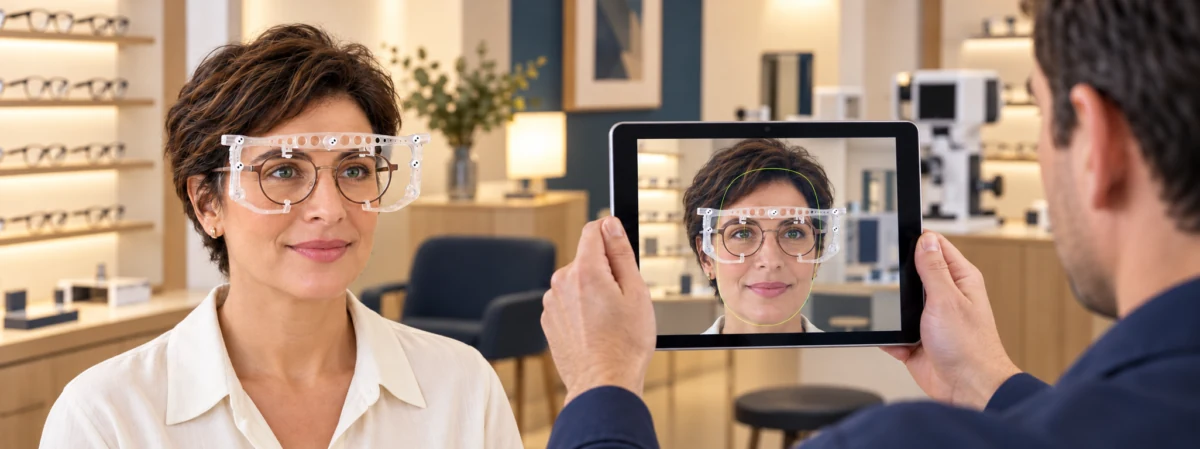
Even the best lens cannot perform as designed unless it is positioned correctly in front of your eyes. After adjusting the frame to your face, we attach the measurement clip and take digital fitting measurements with ZEISS i.Terminal on iPad.
Depending on the lens design and frame, we measure:
- Monocular PD: the distance from each pupil to the center of the nose
- Fitting height: the vertical position of each pupil in the frame
- Vertex distance: the distance between the lens and the eye
- Pantoscopic tilt: the forward tilt of the frame
- Wrap angle: the curve of the frame around the face
The Formula for Comfort
Accurate prescription + suitable lens design + suitable frame + precise measurements + correct fitting. If one of these is missing, even the most advanced lens cannot deliver what it was designed for.
Why Frame Choice Matters
The size, shape and position of your frame determine where the viewing areas sit in the lens. That is why we choose the frame and lens together, check that the frame is deep enough for the selected design, and adjust the glasses on your face when you collect them.
Adapting to Progressive Lenses
Progressive lenses take a little getting used to, and that is completely normal. Some people feel comfortable from the first day; others need a few days or around two weeks. It depends on the lens design, on you, and on whether you have worn progressive lenses before. Try not to compare yourself with others.
Tips for Your First Few Days
- Wear your glasses regularly; your eyes adapt faster with consistent wear.
- To look at something to the side, turn your head and point your nose toward it, rather than moving only your eyes to the edge of the lens.
- Take extra care on stairs and uneven ground during the first days.
- Drive only once you feel fully comfortable with your new glasses.
When you collect your glasses, we show you how to use each area of the lens. During the first days, you are not on your own: you are welcome to visit us anytime, and we will follow up with you and fine-tune the frame on your face so you feel at home in your new glasses as quickly as possible.
And if you haven’t adapted within 30 days of collection, we’ll replace them with bifocal lenses free of charge. Read the full Eye 2 Eye Guarantee.
Materials, Coatings and Sun Lenses
Depending on the product and your prescription, progressive lenses are available:
- In thinner, lighter high-index materials
- With light-adaptive technologies such as Transitions and ZEISS PhotoFusion X
- With anti-reflective and easy-clean coatings
- As prescription sunglasses, including polarized options, in any of our 70+ sun lens colors
Blue-light filtering is an optional extra. It does not replace the lens design itself for reading and screen work.
Why Choose Eye 2 Eye?
- Experience since 2005, with thousands of progressive lenses fitted.
- Ongoing training with ZEISS, Essilor and ASAHI-LITE.
- A precise eye exam before any recommendation.
- Digital fitting measurements with ZEISS i.Terminal.
- Lenses from ZEISS, Essilor and other leading manufacturers.
- A 30-day eye exam guarantee.
- Follow-up in the first days, and free frame adjustments for life.
Frequently Asked Questions
Why Do Progressive Lens Prices Vary So Much?
Two lenses can carry the same prescription and still feel completely different. Budget progressives usually use a standard, one-size-fits-all design, with narrower clear zones, more blur at the edges and a longer adjustment period. Higher levels are calculated point by point with digital surfacing, and the top designs are personalized to your frame and how it sits on your face, using ZEISS i.Terminal measurements. The result is wider zones for reading and screens, smoother transitions and faster adaptation. Lens thickness, protective coatings and light-reactive options also affect the price. The most expensive lens isn’t right for everyone, so we recommend the level your eyes and daily routine actually need.
What Are Progressive Lenses?
Progressive lenses, also called no-line multifocal or varifocal lenses, are prescription eyeglass lenses that combine distance, intermediate and near vision in one pair, with no visible line. They usually suit people over 40 who are starting to find reading harder.
Progressives for Computer Work?
Everyday progressive lenses cover computer distance. If you spend long hours at a desk, a second pair with office lenses gives you a wider area for near and intermediate vision. Office lenses are not designed for driving.
Progressives or Bifocals?
Progressive lenses cover distance, intermediate and near vision with no visible line. Bifocal lenses have two zones only, distance and reading, with a visible line, a wider reading area and a lower price. Separate glasses each serve one distance. The right choice depends on your prescription and daily tasks.
Can I Get Them as Sunglasses?
Yes, and as photochromic lenses too, for most products and prescriptions. If you want your lenses to darken while driving, tell us before ordering: most standard photochromic lenses do not darken enough behind a car windshield. In that case, another product or prescription sunglasses may suit you better.
How Long Does Adapting Take?
Some people feel comfortable from the first day; others need a few days or around two weeks, depending on the lens design and their experience with progressive lenses. During that time, we follow up with you and fine-tune the frame on your face.
What If They Don’t Feel Right?
We are confident in the accuracy of our eye exams, and we want you to feel the same. That is why your exam is guaranteed for 30 days from collection. Take your time with your new glasses, and if they do not feel right, come back and we will re-examine your eyes, or bring a prescription from any ophthalmologist or optometrist, and we will make new lenses at our cost. Any error on our side, such as lens cutting, pupillary distance or fitting height, we fix right away, free of charge. And if you haven’t adapted to your progressive lenses within 30 days, we’ll replace them with bifocal lenses free of charge. Read the full Eye 2 Eye Guarantee.
Choose Your Lenses at Eye 2 Eye
Our service covers selection, measurement, fitting, adjustment and follow-up after collection. Visit us in Amman, and bring your current glasses and your prescription if you have one, so we can discuss your needs and compare your progressive lens options together.