Bifocal Lenses
After 40, reading and close work get harder for most people. It’s a natural change in the eye called presbyopia. If you keep switching between distance glasses and reading glasses, bifocal lenses put both in one pair.
At Eye 2 Eye Optical in Amman, we make every type of bifocal, with lenses from ZEISS, Essilor, Rodenstock, KODAK, and ASAHI-LITE. We start with a precise eye exam, then measure the position of the reading segment for each eye in your own frame.
What Are Bifocal Lenses?
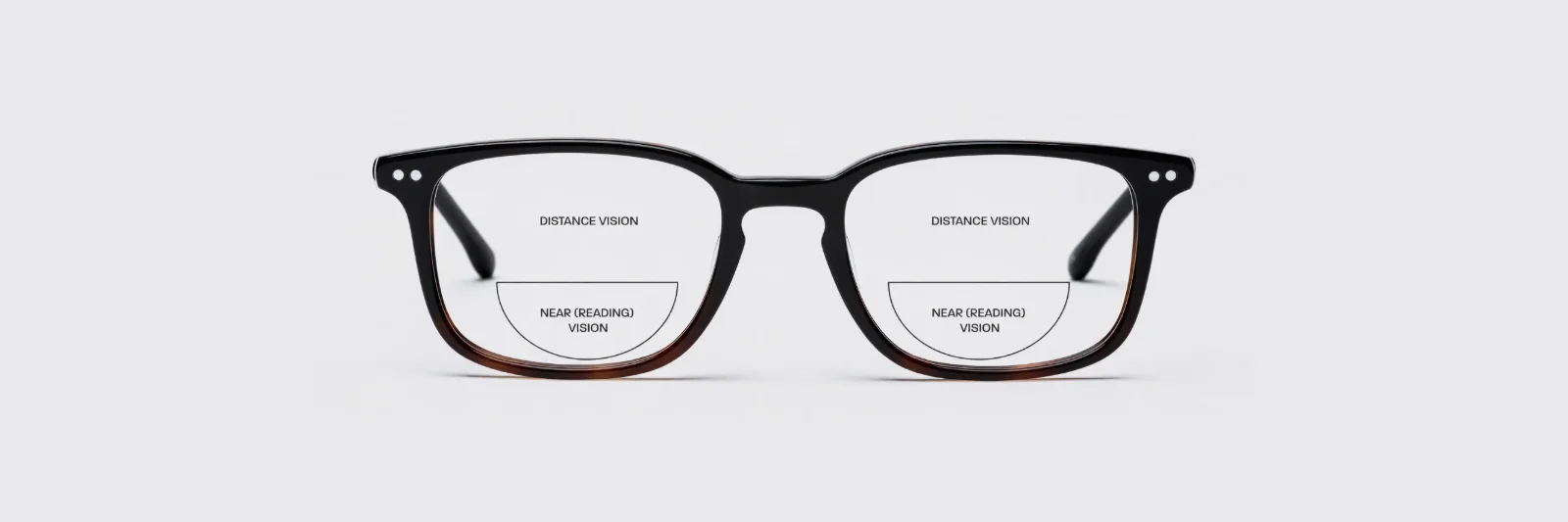
A bifocal lens holds two prescriptions. The upper part is for distance, and a smaller segment at the bottom is for reading and close work, with a visible line between them. Look straight ahead to see far away, and lower your eyes slightly to read.
They differ from progressive lenses, which add an intermediate zone for computer distance and have no visible line.
Types of Bifocal Lenses
The types differ in the shape and size of the reading segment, which decides how much reading area you get, how the lens looks, and how easily you adapt.
Flat-Top Bifocals (D28 and D35)
The most popular design. The reading segment has a straight top edge and comes in two widths: 28 mm for everyday use, and 35 mm for people who read or work at a desk for long hours. It’s usually the easiest to get used to, because the shift between the two zones is gentler.
Executive Bifocals
The reading area runs across the full width of the lens, giving you the widest field for reading and detailed close work.
Round Segment Bifocals
The reading segment is round and its line is less noticeable than in other designs, but the reading area is smaller.
Not sure which type suits you? Stop by with your current glasses, and we’ll pick the design together based on how you read and work.
Bifocal or Progressive?
| Bifocal | Progressive | |
|---|---|---|
| Viewing zones | Distance and near | Distance, intermediate, near |
| Visible line | Yes | No |
| Reading area | Wide | Somewhat narrower |
| Computer work | No dedicated zone | Suitable |
| Price | Lower | Higher |
If you spend long hours at a computer, progressive lenses are usually the better fit. If you mainly need distance and reading, and want a wide reading area at a lower price, bifocals are a practical, comfortable choice.
Who Are Bifocals For?
- People over 40 who need one pair for distance and another for reading.
- Longtime bifocal wearers who are comfortable with them.
- Avid readers who want a wide, clear reading area.
- People who never got comfortable with progressive lenses.
- Children, when an eye doctor prescribes them.
Age alone doesn’t decide it. Your eye exam results and your daily routine do.
Segment Position Matters
The reading segment has to sit in exactly the right spot, usually close to the level of your lower eyelid. Too high, and it gets in the way of your distance vision. Too low, and reading becomes tiring.
So we adjust the frame to your face first, then measure the segment height for each eye separately, based on your frame, your posture, and the way you use your glasses.
The Right Frame for Bifocals
A bifocal lens needs a frame with enough depth to hold both the distance zone and the reading segment. A very shallow frame shrinks your reading area.
That’s why we choose the frame and the lens together from our eyeglass frames, and make sure the frame sits securely, because any slipping moves the reading segment away from where your eye needs it.
Bifocals for Children
We make bifocal lenses for children when an eye doctor prescribes them, for conditions the doctor determines. They are measured differently from adult bifocals: we set the reading segment according to the doctor’s instructions, so the child actually uses it when reading.
We examine patients aged 12 and older. Younger children are referred to a pediatric eye doctor, and we then make the glasses to that prescription.
Your First Days with Bifocals
When your eyes move from the distance zone into the reading segment, the image may seem to jump slightly at first, and stairs may look closer than they are. This is normal and usually settles within a few days.
- Wear your new glasses all day, and don’t go back to your old pair.
- When walking or going down stairs, tip your head down slightly and look through the upper part of the lens.
- When reading, lower your eyes into the reading segment and hold your book or phone at a comfortable distance.
At pickup, we show you how to use each part of the lens, and you’re welcome back anytime for a frame adjustment.
Bifocal Lens Options
Depending on the design and your prescription, bifocal lenses are available:
- As high-index lenses, thinner and lighter for stronger prescriptions.
- As photochromic or Transitions lenses that darken in sunlight and clear up indoors.
- As prescription sunglasses, tinted or polarized, in more than 70 colors.
- With anti-reflective coating, which comes on every lens we make.
Why Choose Eye 2 Eye?
Because bifocals succeed on more than the lens itself. They depend on an accurate exam and a precisely placed reading segment. Here is what sets us apart:
- Every design: flat-top D28 and D35, executive, and round segment.
- A precise eye exam before any recommendation.
- Segment height measured for each eye separately.
- Genuine lenses from ZEISS, Essilor, Rodenstock, KODAK, and ASAHI-LITE.
- We recommend bifocal or progressive based on your needs, not the price.
- A 30-day eye exam guarantee.
- Free frame adjustments for life.
- Experience since 2005.
Frequently Asked Questions
What is a lined bifocal?
It is another name for the same lens: distance vision on top, a reading segment below, and a visible line between the two.
How long do bifocals take to get used to?
Usually a few days to two weeks. Many people adapt faster, especially when they wear the glasses all day.
Are bifocals good for computer work?
They are not the best choice, because they have no zone for screen distance. For long hours at a computer, we usually suggest progressive or office lenses.
Which bifocal is best for reading?
For long reading sessions, a wider segment such as the flat-top D35 or the executive gives you a more comfortable reading area.
Can I switch from bifocals to progressives?
Yes. We help you find out whether progressive lenses suit your work and your day before you decide.
Can bifocals be made as sunglasses?
Yes. We make them as prescription sun lenses, tinted or polarized, in any of our sun lens colors.
Do you make bifocals for children?
Yes, when an eye doctor prescribes them. We measure and fit them carefully so the reading segment sits exactly where it should.
How long do my glasses take?
From 24 hours to 7 days, depending on the lens type and availability. We tell you the timing when you order.
What determines the lens price?
The bifocal design, the lens index, the coating, whether the lens is clear, photochromic, or tinted, and the manufacturer. When you visit, we show you several options and explain the difference.
What does our guarantee cover?
We are confident in the accuracy of our eye exams, and we want you to feel the same. That is why your exam is guaranteed for 30 days from collection. Take your time with your new glasses, and if they do not feel right, come back and we will re-examine your eyes, or bring a prescription from any ophthalmologist or optometrist, and we will make new lenses at our cost. Any error on our side, such as lens cutting, pupillary distance or fitting height, we fix right away, free of charge. Read the full Eye 2 Eye Guarantee.
Choose Your Lenses at Eye 2 Eye
Visit us in Amman and bring your current glasses and your prescription, if you have one. We examine your eyes, talk through your day, and work out with you whether bifocal or progressive lenses suit you better from our range of prescription lenses.